



Build financial statements
through conversations.
Arus keeps proper double-entry books for a small business without asking anyone to learn accounting. It asks what happened. It writes the entry.
Not released yet. The engine below is built and tested, but Arus is not open to use. Leave an address and we will tell you when it is.
This month
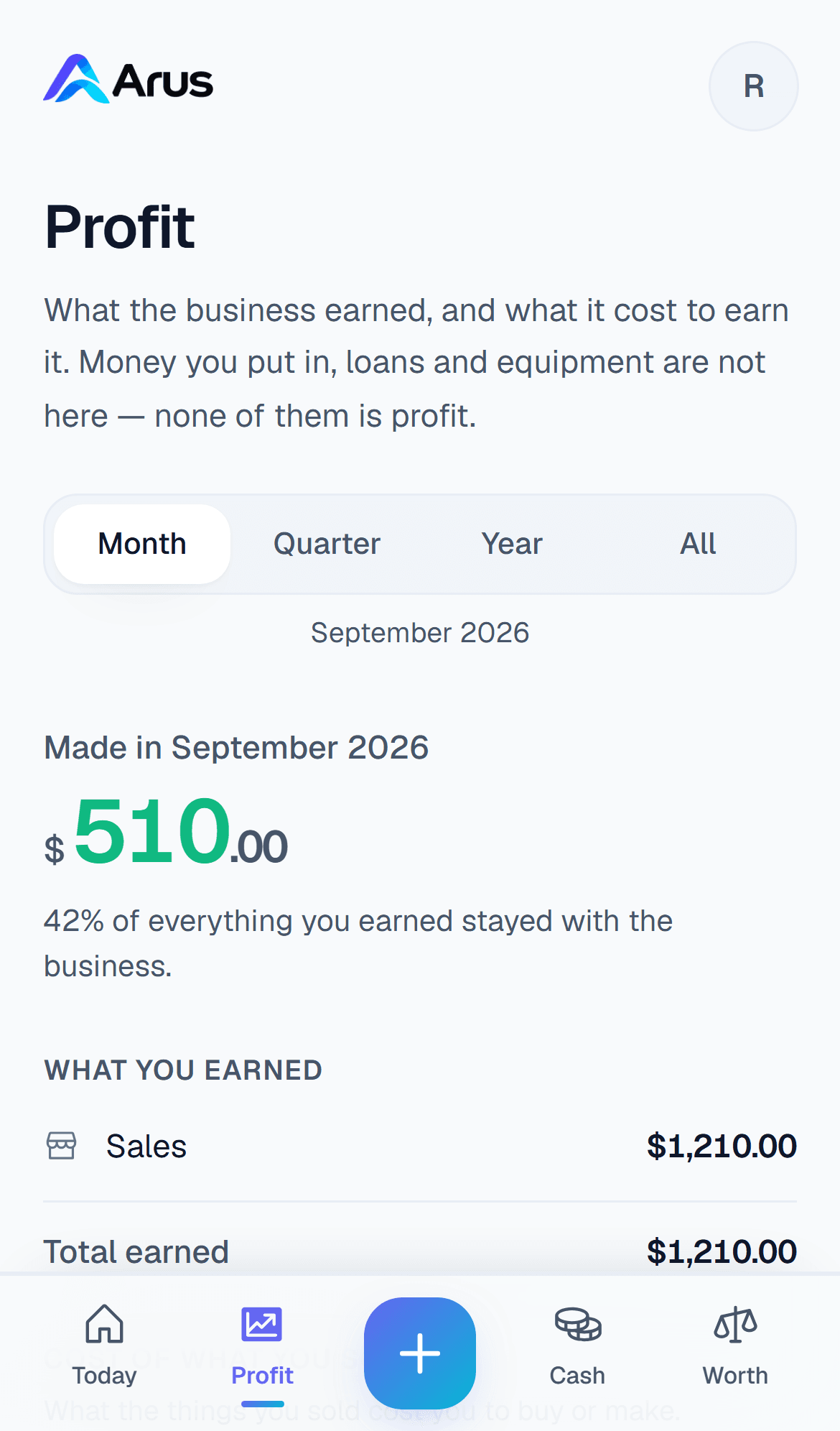
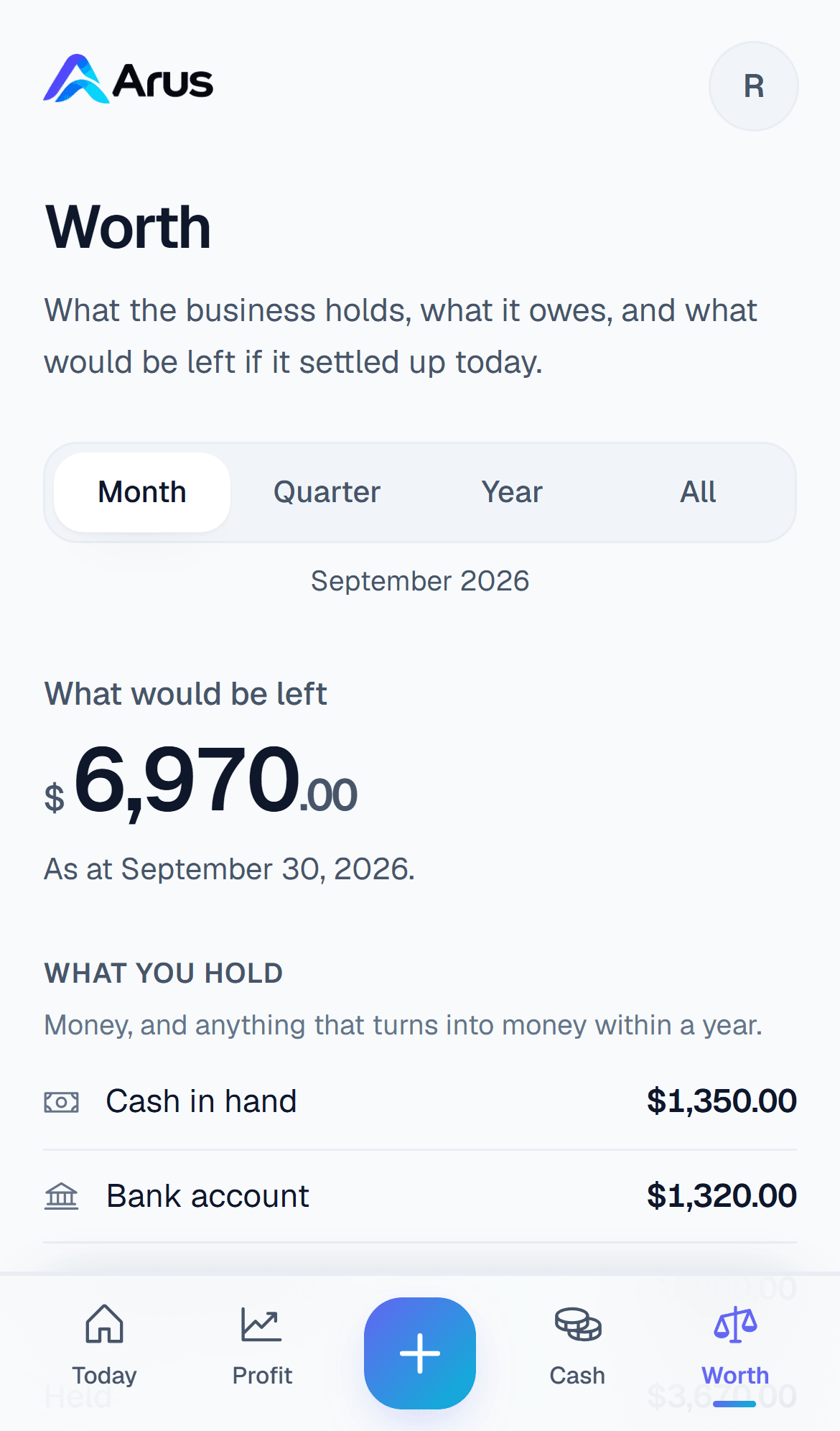
The same entries produce the balance sheet and the cash flow statement too. They agree because none of the three is stored — each is a question asked of one journal.
One question, one entry
Bookkeeping software usually hands a small business a form — accounts, debits, credits, tax codes — and asks it to already know accounting. Arus turns that around.
- 1
You answer
Someone paid me for something I sold. I bought stock. I paid a bill. Plain questions, asked in the order they make sense.
- 2
Arus posts it
Each set of answers resolves to one balanced journal entry. The accounting happens where it belongs — out of sight, and correctly.
- 3
The books follow
Profit, what the business holds, and where the cash actually went. All three derived from the same journal, so they cannot contradict each other.
What it looks like
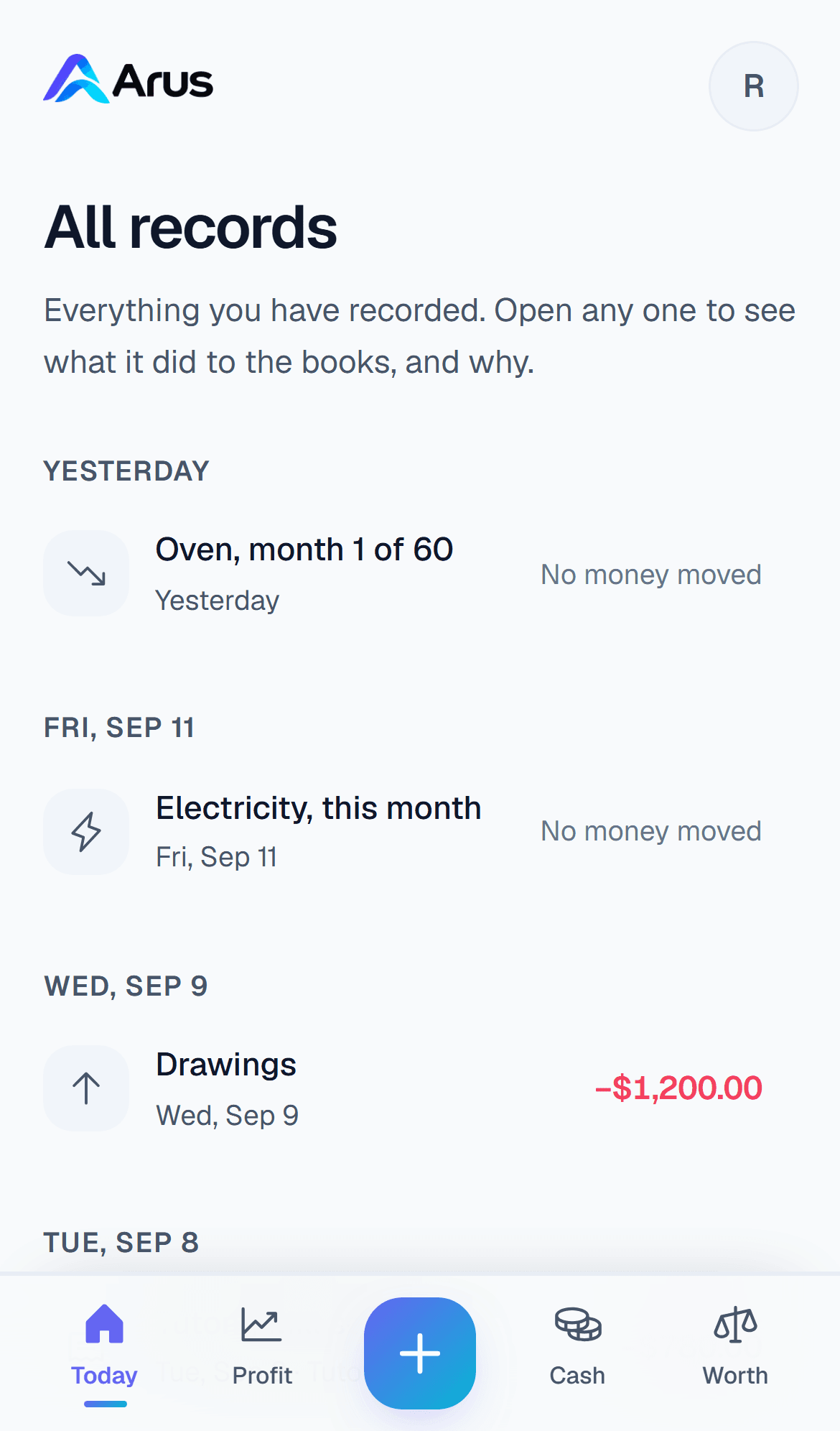
Photographed from the working build. Arus is not open to use yet, but it is real — these are its screens, not a design.

What it does
Asks, rather than tells
No accounts to pick, no debits and credits to balance, no tax codes. Arus asks what happened in the words an owner would use, and works the entry out from the answers.
Real double-entry underneath
The plain questions are the surface, not the substance. Every answer becomes a balanced journal entry, so the books are ones an accountant or a bank will recognise.
Business and personal, kept apart
Money the owner puts in and money the owner takes out are recorded as what they are. That is where small books usually go wrong first, so it is handled from the start.
Built for the counter, not the desk
Recording takings or a cost is a few taps on a phone in the gaps of a working day, rather than an evening with a spreadsheet at the end of the month.
The books balance, and we check
Every build runs 1,167 checks against generated books, asserting the identities that have to hold for the statements to mean anything: assets equal liabilities plus equity, and opening cash plus what moved equals closing cash. If one of them failed, the build would not ship.
For businesses without a bookkeeper
The market stall, the home kitchen, the two-person workshop. Real enough to need books, small enough that nobody is employed to keep them.
If that is you, tell us what your books actually have to do — it is how we decide what Arus needs before it opens. Write to arus@kapix.io.